Barry William Hale - Demonomania Rhizomata
Barry William Hale is an artist whose works I have admired for many years. They are fascinating and deeply engaging due to the direct connection he draws from magickal practice. There is no appropriation of esoteric language or pretence of occult knowledge in the works, the depth of understanding is immediately obvious when viewing the outcomes of his art practice. In an interview with curator Caroline Tully Hale describes his practice:
All my work is the residue of engagements with magic. My artistic practice can be seen as a series of different explorations of magic that I return to time and time again. I develop them through aesthetic elaboration and magical research, adding to an existing corpus of knowledge which continues to grow and inform itself.
I really connect with this expression of his practice as it is akin to how I see my own relationship with my work and it makes me wonder if this is the case for many artists who also work in this way.
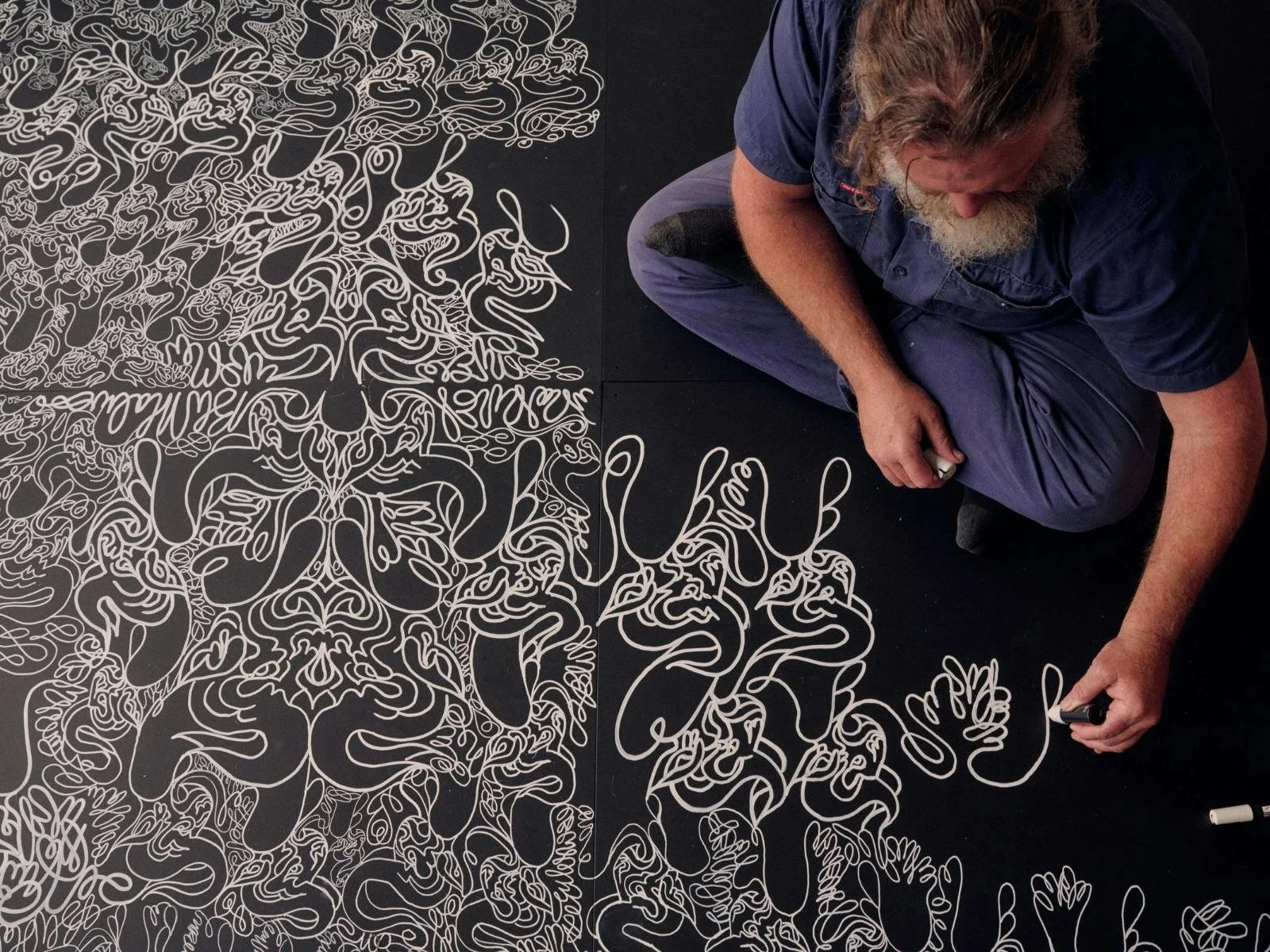
Demonomania Rhizomata 2025 Paint pen on aluminum Commissioned by State Library of Victoria
Moving across many mediums from papercuts, to painting, to virtual reality Hale uses the forms to express his ‘residue of engagements with magic’ in striking ways. In this piece I want to focus on an exhibition held at the State Library of Victoria in 2025. Not only is the work visually stunning but the concept around this artistic creation sheds light on both Hale’s process and the magickal influence of materials within the library collections. The project was presented as part of a program that frames creative practice as a form of research into the numinous including a selection of artist who work in this realm.
The focus of Hale’s room is a monumental line drawing on aluminium titled “Demonomania Rhizomata”. This piece focuses on how Hale translates esoteric practice into visual form with the work being a living expression of the ritual practice that created it. Hale creates work which bridges the conscious and unconscious, the pieces act as conduits between the two states of being which is especially evident in Demonomania Rhizomata, an example of automatic drawing.
This process is very interesting to me personally I think for the same reasons that it is to Hale. To activate these works the artist has to move into a kind of trance state which allows the veil of the conscious to slip away so the artist has access to the “other”. Because the artist is ‘doodling’ in the sense that there isn’t a conscious effort, the lines take on a flowing calligraphic form which can look sometimes like letters, sometimes like recognisable images and often like roiling waves. Interestingly the form can be improved with practice as the artist develops a style which doesn’t require thought to activate. You can see this in Hale’s work where certain forms are repeated over and over. It seems to me that these forms have become embedded through return to the practice allowing Hale to access them effortlessly when needed.
This way of creating has a long history not just in esoteric practice but also in the art world by the Surrealist movement under André Breton. This group of modernist artists had an interest in the spiritual world but kept a distance from it using automatism in a more psychologically leaning way influenced by early psychologists such as Freud. On the other hand automatism has been unashamedly used by esoteric practitioners as a method of magickal communication drawing directly on the unconscious. One of the most famous early modern practitioners was British occultist Austin Osman Spare. Spare’s work is known not just for the powerful nature of its magickal potency but for the delicacy of his linework and construction. Hale’s large automatic piece is redolent of some of Spares most beautiful work.
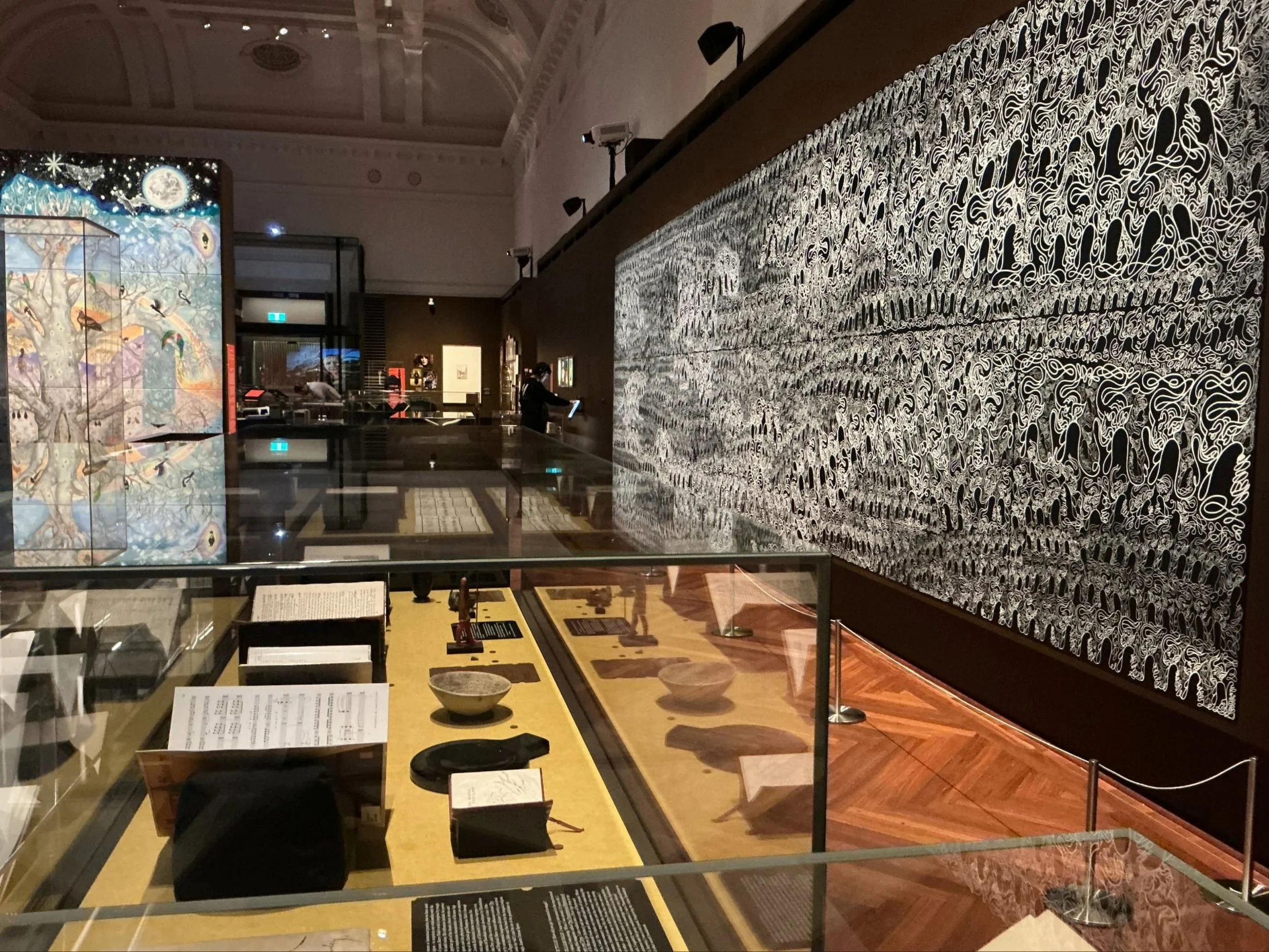
Alongside Hale’s large piece are a number of cabinets displaying items from the library collections. These are as much catalysts of the exhibitions as the artworks themselves; they are brought alive by their proximity to Hales work and in turn his work is expanded by its place within them. Hale’s library commission challenges institutional neutrality by lifting occult objects out of antiquity as merely curios and showcasing their present magical potency in a live setting. Within these cases these are automatic works by Austin Osman Spare, alongside Aleister Crowley texts, various ritual and mystic documents which ground Hale’s work in the tradition, zoanthropic and rhizomatic images which echo the shapes of his automatic drawing, magickal objects, alongside his magickal notebooks and sketches.
The title of the primary work ” Demonomania Rhizomata” conjures up images of writhing spreading demons which is apropos looking at the continuous calligraphic line which mutates in and out of organic forms, sometimes humanoid and sometimes animalian. In a physical sense a rhizome is a horizontally stemmed spreading plant, a creeping underground network. But in a philosophical sense it’s a way to describe the growth of unpredictable ideas; connectivity between apparently disparate thoughts, a multiplicity of interacting parts, a difficult cartography. Isn’t this how ‘demons’ might evolve? The whole idea of the demonic pushes against contemporary beliefs giving it substantial power. But what are they really? Hale observes the ebb and flow that’s moves beneath our consciousness acting as the conduit directly experiencing its unfolding so we can see the map.
State Library of Victoria