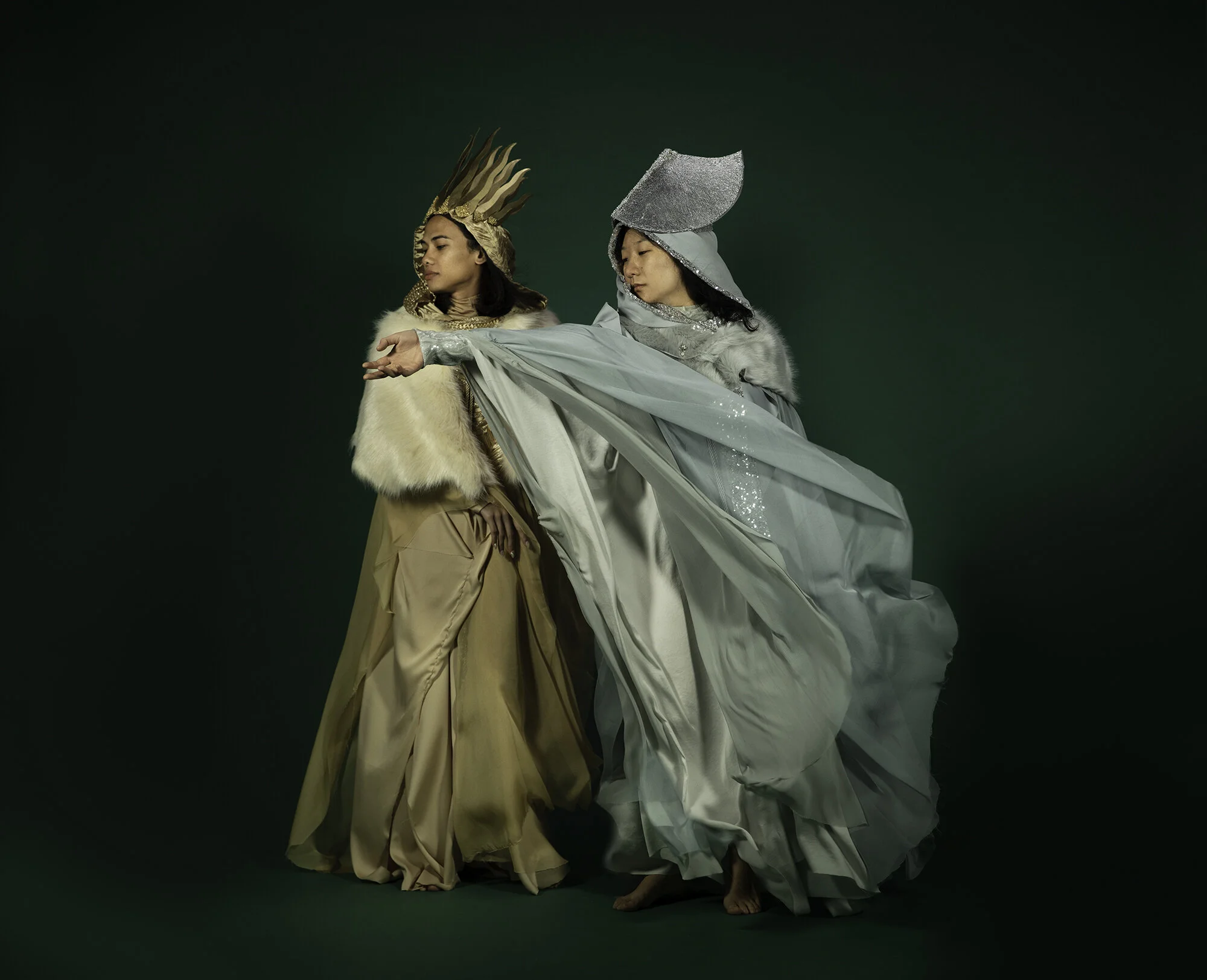
A celestial body is a naturally occurring physical entity, such as a sun, planet, moon, or asteroid that exists in the observable universe. Over the course of human history, there has existed an evolving relationship between us and our most influential celestial bodies; the sun and the moon. They inspire humanity, they impact us by their very existence, but still, historically in myth and story, we have given them extra power by imbuing them with personality, motive and even deification.
In the case of this work, Sol and Luna allow us to see them in their humanised forms as they travel their intersecting paths across an idyllically scenic yet brooding realm. Sun and moon, gold and silver, pass across the sky meeting once to ‘touch’ in an eclipse redolent of ‘conjunctio’, the alchemical marriage. While we are watching them, only once do they turn to face us and acknowledge our gaze, but even then they look through and beyond us, as if our existence doesn’t touch them at all.
The exhibition presents a nine‑channel video across three screens where Sol and Luna move and intersect creating a looping narrative reflecting the recurring movement of the celestial bodies. The work positions celestial mythology within a contemporary visual framework, highlighting how ancient narratives persist in modern visual culture.
Ko tētahi o te whānau mārama he hanga kikokiko ka puta māori noa pērā i te rā, te aorangi, te marama, te aorangi iti rānei kei te ao tukupū ka kitea e te karu. Taka iho i ngā hītori mō te tangata, tērā tētahi hononga kuneroa i waenga i a tātou me ērā o te whānau mārama kawenga nui; te rā me te marama. Whakaohooho ana rāua i te tangata, he pāpātanga ō rāua i te iringa noa mai, heoi anō, heke iho i roto i ngā pakiwaitara, he mana nui atu kua uhia ki a rāua i tā tātou whakatō atu i te tuakiri, te kaupapa, tae atu ki te atuatanga.
Ko tētahi o te whānau mārama he hanga kikokiko ka puta māori noa pērā i te rā, te aorangi, te marama, te aorangi iti rānei kei te ao tukupū ka kitea e te karu. Taka iho i ngā hītori mō te tangata, tērā tētahi hononga kuneroa i waenga i a tātou me ērā o te whānau mārama kawenga nui; te rā me te marama. Whakaohooho ana rāua i te tangata, he pāpātanga ō rāua i te iringa noa mai, heoi anō, heke iho i roto i ngā pakiwaitara, he mana nui atu kua uhia ki a rāua i tā tātou whakatō atu i te tuakiri, te kaupapa, tae atu ki te atuatanga.
E tāpaea ana e te whakaaturanga he ataata hongere-iwa rere i ētahi mata e toru, e rere ai, e whakawhiti ai a Rā rāua ko Marama, e tuhia ai he kōrero hurihuri e whakaahua ana i te nekehanga auau a te whānau mārama. E whakanoho mai ana te mahi i te pakiwaitara mō te whānau mārama ki te anga ataata ao hou, e whakamiramirahia ai te āhua o te kitea tonutia o te kōrero o nehe i te ahurea ataata o te ao hou.
Kuputaka / Glossary
Idyllically scenic yet brooding realm – ao kaurerehu whakapau kanohi
Eclipse – te āraitanga a tētahi i tētahi
Redolent of ‘conjunctio’, the alchemical marriage - me he ‘hononga tapu’
Translation by Te Haumihiata Mason (Licenced Translator)
天体是指存在于可观测宇宙中的自然存在的物理实体,例如太阳、行星、卫星或小行星。在人类历史长河中,我们与对我们影响最大的天体—太阳和月亮—之间存在着不断演变的关系。它们启发着人类,它们的存在本身就影响着我们,但即便如此,在历史上的神话和故事中,我们仍然赋予它们额外的力量,赋予它们个性、动机,甚至神化。 在这件作品中,太阳和月亮以拟人化的形态出现,让我们得以一窥它们在风景如画却又略带忧郁的领域中交错的轨迹。太阳和月亮,金色和银色,划过天空,在日食中相遇,仿佛在暗示着“结合”(conjunctio),炼金术中的结合。当我们注视着它们时,它们只转过身来面对我们,回应我们的目光,但即便如此,它们的目光也穿透了我们,超越了我们,仿佛我们的存在根本无法触及它们。 展览呈现了一部横跨三块屏幕的九频道视频,其中太阳和月亮不断移动交错,构成循环往复的叙事,反映了天体的周期性运动。该作品将天体神话置于当代视觉框架之中,凸显了古老的叙事如何在现代视觉文化中延续。
Translation by Taoran Li and Aria Zhang

Celestial Bodies (Eclipse) installed in CAS Gallery, New Plymouth, 7 May 2022 - 25 June 2022

Lunar Transit (2022) Edition of 10

Theory of Tides I (2022) Editon of 10

Heliospheric Current II (2022) Edition of 10
Celestial Bodies.
“For he is ever a sun, and she a moon. But to him is the winged secret flame, and to her the stooping starlight.”

‘The Alchemist’ from Clavis Artis (1737) Original attributed to Zoroaster

Alchemical marriage between Sun and Moon (1578) Jaroš Griemiller, Rosarium Philosophorum
“Its father is the Sun and its mother the Moon.The Earth carried it in her womb, and the Wind nourished it in her belly, as Earth which shall become Fire. Feed the Earth from that which is subtle, with the greatest power. It ascends from the earth to the heaven and becomes ruler over that which is above and that which is below.
”

From Splendor Solis (1582) a German alchemical treatise, held in the British Library
There’s an old alchemical illustration that has captivated me since the first time I saw it; one of those images that seems to follow you around and keep appearing again and again to worm its way into your psyche. In this strange picture from the Clavis Artis a figure sits in a wooden chair, turned three quarter view and with their left foot in front of the right. Behind them is a sweeping natural landscape with a glowing sky and rolling hills. The figure’s right hand relaxes on
the arm of the chair while their left hand holds a stem with three flowers.
This person is an alchemist and it seems they have reached an enlightened state as their head has taken on the form of a golden sun, seen by alchemists as the divine heart of the macrocosm and a representation of spiritual perfection. Along with his partner the moon, these two celestial bodies perform the ‘conjuctio’ or alchemical marriage, through which the Magnum Opus, the process of attaining perfection or the widely coveted Philosophers Stone, is achieved.
The Red King and White Queen (Sun and Moon) represent a pair of binary opposites; male and female, king and queen, fire and water, active and receptive, whose conjunction creates a perfect union. This symbolic language exists far more universally than just in alchemical texts through the mythology of world wide cultures.
While solar deities are not always understood to be masculine and lunar deities feminine (many cultures have aspects of both that relate to the opposite sex) this is the tradition that has filtered through western esoteric thought from ancient European and Near Eastern civilisations such as Mesopotamia, Egypt and Greece.
It is not surprising that humans have held the sun and the moon in such high regard, even venerating them, when you consider the impact both of these celestial bodies have upon our lives.
Without the sun there would be no life upon the earth, there would be no seasons and no day. Without the moon there would be no tides, there would be no light to guide us when it is dark. They are the two halves of our 24 hour daily cycle, exhibiting their own rhythms as they move with the months or years. The fierce gold and the radiant silver.
Alchemical artworks are loaded with symbolism designed to be understood by adepts while being overlooked by the layperson. A fine example of what is meant, in this case, by the epithet ‘occult’ or ‘hidden’ whereby only those possessed of the correct esoteric knowledge can read the imagery to its full. As well as continuing didactic traditions from illuminated manuscripts these metaphorical artworks often have an unusual way of staging the scene by placing the ‘feature’ of the visual lesson into a pastoral or scenic landscape with which it has little or no connection.
The feature subject is usually larger than it’s surrounds and can appear to float apart from the landscape as if existing in a separate plane.
In this image from Splendor Solis, “The Splendor of the Sun” (1582) attributed to legendary Renaissance alchemist Salomon Trismosin, a red garbed man stands inside a giant flask which floats above a scene of rustic hunting and fishing. The flask sits inside an architectural device which separates it from the landscape as the artist encourages the viewer to hold it in higher regard as the symbolic focus of the entire painting. The Red King in this miniature alludes to the alchemical phase of rubedo which is associated with the production of gold, while above the scene, in her chariot drawn by two maidens, the goddess Luna carries her emblem the crescent moon, alluding to silver.
A celestial body is a naturally occurring physical entity, such as a sun, planet, moon, or asteroid that exists in the observable universe. But I also interpret the appellation as a description of the personhood bestowed upon these insentient entities. The sun, the moon and the planets of our solar system feature so prominently in human thought, from ancient mythology to modern science and everything in between, that the word ‘body’ conjures up both their physical form and the corporeal shape of the deities humanity has made of them.
With this work I wanted to visualise the way, over the course of human history, there has been a backwards and forwards between us and our nearest celestial bodies. They inspire humanity, they impact us by their very existence, but still we give them extra power by imbuing them with personality, motive and even deification: if we don’t give sacrifice to the sun he will burn the crops, if we disrespect the moon she might turn us mad. In our modern lives we are just as beholden to the physical impact of our celestial bodies on the earth even though we now better understand their scientific nature. In the case of this work, Sol and Luna allow us to see them in their human forms as they travel their intersecting paths across a dark and brooding scenic stage. They perform at points of the day, invoking aspects of their duality in gestures from ceremonial ritual. The work evokes the strange theatricality of alchemical illustrations with the individual pictorial frames forming a story, a disconnected landscape and figures that stand out from their background directing the viewer to observe the symbolism in their movement.
While the visual aspect of the work describes the mythological personification of these two celestial bodies, the soundscape embodies their material influence upon the Earth by using both lunar tidal patterns and solar activity data to inspire otherworldly sounds made with crystal singing bowls. These were recorded during a full moon and a time of a coronal mass ejection. The bowls are uniquely resonant having both clear natural qualities and also sounding so unusual as to have come from the cosmos itself. Long, low tones evoke the silvery moon and sharp, staccato chimes, the brilliance of the sun.
Sun and moon, gold and silver, pass across the sky meeting once to ‘touch’ in an eclipse redolent of the alchemical marriage. While we are watching them, only once do they turn to face us and acknowledge our gaze, but even then they look through and beyond us, as if our existence doesn’t touch them at all.